Passion/Patin/Vitesse - Passion/Speed/Skating: Carl Savard

Colombia and France stand out in Ibagué

Inline speed skating world championships recap

La Colombie et la France se démarquent à Ibagué

Résumé des championnats du monde de roller 2021

The Canada Roller Marathon 2021: Moving forward

Canada Roller Marathon is back after 2020 hiatus

Le marathon roller du Canada 2021: Aller de l'avant

Retour du Marathon roller du Canada après une pause en 2020

Nos autres adresses / Our other spaces

Venez nous rejoindre! / Come and join us!

Pages

Aucun message portant le libellé Carl Savard. Afficher tous les messages

16 mars 2020

Lara van Ruijven: "I hope when the time comes, someone will tell me ‘It was nice, but now you’re done!’"


Lara van Ruijven is one of the reasons why the women’s short track team in the Netherlands is presently at its golden age and she hopes she can still have a positive impact on the team for a few more years.

By Carl Savard
Photos by Danny Kim, Oscar van den Bosch and Lara van Ruijven's personnal collection

Lara van Ruijven was a bit shy when we started chatting. From the get go, she told me she was a bit nervous when answering questions in english. The Dutch athlete says her french was good when she was young but she lost it and she then learned english in high school. After a few minutes of small talk and basic questions, it became evident that her english was much better then she made it sound and I was able to get to know more about the 2019 500m world champion. 

Born in Naaldwijk, a small community sitting just outside of The Hayes, Lara van Ruijven’s debut on the ice happened at a young age. “Speed skating entered my life when I was six years old. I started in long track and a friend of mine, Adwin Snellink, was skating too. One day our parents were chatting and talked about the possibility of me trying short track. I tried it and never went back to long track other than to work on things that could help me in short track.” Van Ruijven grew up in a family where sport was important. “I grew up playing soccer, tennis, practicing short track and field hockey. My father used to be a cyclist when he was young and my mom played tennis. My older brother was also playing field hockey. I was part of an active family. When I was about 10 years old, one of my dream was already to be olympic champion but I didn’t know if it was going to be in short track or field hockey. When I was seventeen I was invited to join the training center in Heerenveen and it’s at that moment that skating became more serious. At the time, I was in my last year of high school and I felt kind of sad that I had to move to another school to join the program and miss my graduation ball, but there was no way I was going to decline the invitation.” 


Moving to Heerenveen and joining the national team meant being trained by Jeroen Otter, arguably the best coach in the short track world at the moment. “Jeroen is always telling you the truth, even the things you don’t want to hear. He is really straightforward and doesn’t care if it’s something nice or not and it’s a good quality in a coach. He always wants to evolve and he doesn’t likes routine. He’s always looking for new things to help us get better like having skaters from other countries training with us. Some people are afraid to share their ways of training but I don’t think there are really big secrets surrounding it. I think it’s a great way to learn and it pushes you to get better. I also like the fact that we are with the boys on the ice during training. I can’t imagine being only with the girls. Even just for the atmosphere it’s great. Boys are more relaxed in training, they make jokes, releasing the pressure and I think it’s good.”

During the discussion, we talked for a moment about how much the program has evolved since she joined. “I remember when I joined the team, we were not that good in the relay even though the young ones joining now see us as a top team. We had to work hard. I remember we couldn’t follow in the relay and in the last ten laps there was always a gap between us and the leaders. Now the young skaters know that if they join the team there is a good chance they are going to skate for an A final.”  Other than the relay results, van Ruijven's career also grew fast. After starting by being a great relay athlete and eventually climbing the individual rankings, 2019 saw the 27-year-old become world champion. While working towards reaching the top is hard, staying there is even more difficult. “When I got back to training I was more relaxed than the previous season. Instead of thinking ‘I had a good season but didn’t get the medals and need to do more’ I was thinking “Oh I did it!’ and maybe that’s why at the beginning of the season I wasn’t as hungry as I used to be in the previous seasons and didn’t give the extra push needed to win. Even though everyone told me I would feel the pressure now that I had become a world champion, I didn’t really. I love the competition even though I’m always so nervous when the season starts. I’m not a beast in training and I have difficulties knowing where I stand when I’m not competing so competition feels good.”


Talking about competition, the men’s 500m has always been seen as the big show in short track, but for the last two seasons, the women’s 500m has been just as amazing. As reigning world champion on the distance, van Ruijven has to battle against the strongest group of women to ever race the distance in Martina Valcepina, Yara van Kerkhof, Natalia Maliszewska, Qu Chunyu, Fan Kexin and world record holder Kim Boutin. “It’s super fast right now and more women are performing at a higher level. It’s exciting for the fans but it’s exciting for the skaters too. It feels good just being in an A final now.”

With the season that just ended abruptly, we now are more than halfway through the olympic cycle leading to Beijing 2022. Like most athletes competing in an olympic driven sport, Lara van Ruijven’s focus is set on the Games. Although she seems to be reaching her peak, she also feels like her career is closer to the end than the beginning. “I can’t see myself still skating when I’m 34 like Charles Hamelin or Viktor Ahn. When I went to the Sochi Olympics I knew I was going to help the relay and was skating the 500m but I was not that good and thought ‘Next Olympics in Pyeongchang I’m going to skate the 500m again and win a medal and quit” but it didn’t go as planned. After Pyeongchang I didn’t feel like quitting despite not getting the results I had in mind. I felt I still could do much better. So now, I’m working on Beijing with the same goal of winning and I’ll evaluate what I do after the Games. Maybe I’ll skate one or two seasons after Beijing 2022 and then concentrate on studying law. I know now I’ll quit when I feel like I can’t get better but right now I’m still having fun. I discovered in the last few years that you can have plans but it doesn’t really mean anything. You can’t know in advance what is going to happen in your personal life and your athlete’s life. I don’t want to have a pathetic ending to my career. I hope when the time comes someone around me will tell me ‘Lara, quit! It was nice but now you’re done!’”

Don't forget to subscribe to our newsletter, follow our Facebook page, our Instagram account and our Twitter account for daily news and results about speed skating.

Lara van Ruijven: "J'espère qu'en temps opportun quelqu'un saura me dire 'C'était bien, mais c'est le temps d'arrêter!'"


Si l’équipe féminine néerlandaise en patinage de vitesse courte piste est présentement à son âge d’or, c’est en partie grâce au brio de Lara van Ruijven. Cette dernière espère bien continuer d’avoir un impact positif sur les résultats de son équipe pour quelques années encore. 

Par Carl Savard
Photos par danny Kim, Oscar van den Bosch et collection personnelle de Lara van Ruijven

C’est de façon un peu timide que mon entretien avec Lara van Ruijven a débuté. D’emblée, elle a tenu à me dire qu’elle était un peu gênée lorsqu’elle devait répondre à des questions en anglais. Nous avons donc débuté l’entretien de manière relaxe, à jaser de tout et de rien. Elle m’a confié qu’étant jeune elle parlait bien le français mais qu’avec le temps elle a oublié. Elle a par la suite appris l’anglais à l’école secondaire et je me suis rapidement rendu compte que son anglais était bien supérieur à ce qu’elle laissait sous-entendre. J’ai donc passé quarante belles minutes à discuter avec la championne du monde 2019 sur 500m. 

Native de Naaldwijk, une petite agglomération en banlieue de La Haie, les débuts sur glace de la petite Lara ont eu lieu à l’âge de six ans. C’est sur l’anneau de 400m qu’elle a chausser les patins pour la première fois. C’est suite à une discussion entre ses parents et ceux d’un ami habitant sur sa rue (Adwin Snellink qui joindra lui aussi plus tard l'équipe nationale) que la transition vers le courte piste s’est enclenchée. «Je me souviens que je n’étais pas très bonne en longue piste. Après avoir essayé en courte piste, je ne suis jamais retournée à la longue piste à part pour entraîner les aspects qui pourraient m’aider en courte piste.» Dans la famille de Lara van Ruijven, le sport a toujours été important. «J'ai grandi en jouant au soccer, au tennis, en pratiquant le hockey sur gazon et le patinage de vitesse. Mon père était cycliste quand il était jeune et ma mère jouait au tennis. Mon frère aîné jouait tout comme moi au hockey sur gazon. Je faisais partie d'une famille active. Quand j'avais environ dix ans, un de mes rêves était de devenir championne olympique un jour, mais je ne savais pas si ce serait en courte piste ou en hockey sur gazon. À dix-sept ans, j'ai été invitée à rejoindre le centre d'entraînement de Heerenveen et c'est à ce moment que le patinage est devenu plus sérieux. À l'époque, j'étais en dernière année à l’école secondaire et je me sentais un peu triste de devoir changer d'école pour rejoindre le programme et de manquer mon bal de fin d'études avec les amis avec qui j’étais allée à l’école tout mon secondaire, mais il n'était pas question que je décline l'invitation». 


Déménager à Heerenveen et joindre le giron de l’équipe nationale néerlandaise c’est entrer en contact avec Jeroen Otter, l’un des meilleurs coachs en courte piste sur la planète. «Jeroen vous dit toujours la vérité, même les choses que vous ne voulez pas entendre. Il est franc et ne passe pas par quatre chemins. C'est une bonne qualité pour un entraîneur-chef. Il veut toujours évoluer et il n'aime pas la routine. Il est toujours à la recherche de nouvelles façons pour nous aider à nous améliorer, comme entre autres le fait d'avoir des patineurs d'autres pays qui s'entraînent avec nous. Certaines personnes ont peur de partager leur façon de s'entraîner, mais je ne pense pas qu'il y ait de grands secrets autour de cela. Je pense que c'est une excellente façon d'apprendre et que cela vous pousse à vous améliorer. J'aime aussi le fait que nous soyons avec les garçons sur la glace pendant l'entraînement. Je ne peux pas m'imaginer être seulement avec les filles. Même juste pour l'ambiance, c'est génial. Les garçons sont plus détendus à l'entraînement, ils font des blagues, relâchent la pression et je pense que ça fait du bien à tout le monde.»

Le programme néerlandais a eu une progression constante et impressionnante mais Lara van Ruijven se souvient des débuts plus difficiles. «Même si les jeunes qui nous rejoignent maintenant nous voient comme une équipe de haut niveau, je me souviens que lorsque j'ai rejoint l'équipe, nous n'étions pas très bons dans le relais. Nous avons dû travailler dur. Je me souviens que nous ne pouvions pas suivre les autres équipes et dans les dix derniers tours, il y avait toujours un bon écart entre nous et les meneurs. Maintenant les jeunes patineurs savent que s'ils rejoignent l'équipe, il y a de bonnes chances qu'ils patinent pour une finale A.»  Outre les résultats aux épreuves de relais, la carrière de van Ruijven a également connu une croissance rapide. Après avoir été une grande athlète en équipe et avoir gravi les échelons des classements individuels, 2019 a vu l’athlète de 27 ans devenir championne du monde. S'il est difficile de travailler pour atteindre le sommet, il est encore plus difficile d'y rester. «Quand je suis revenue à l'entraînement après mon titre aux championnats du monde, j'étais plus détendue que la saison précédente. Au lieu de penser 'j'ai fait une bonne saison mais je n'ai pas eu les médaille et je dois en faire plus', je me disais 'Oh, j'ai réussi !' et c'est peut-être pour cela qu'en début de saison, je n'étais pas aussi affamée que les saisons précédentes. Je crois que je n'ai pas instinctivement donné l'effort supplémentaire nécessaire pour gagner. Même si tout le monde m'a dit que je ressentirais la pression maintenant que j'étais devenue championne du monde, ce ne fut pas vraiment le cas. J'aime la compétition, même si je suis toujours très nerveuse quand la saison débute. Je ne suis pas très bonne à l'entraînement et j'ai des difficultés à savoir où je me situe quand je ne suis pas en compétition, alors la compétition me fait du bien».


En parlant de compétition, les dernière saisons semblent avoir ramené le 500m chez les femmes à l’avant plan et la Néerlandaise est en partie responsable de l’engouement entourant l’épreuve. En temps que championne en titre, van Rujiven doit tenter de contenir les attaques du plus rapide groupe de sprinteuses de l’histoire en courte piste. Un groupe comptant dans ses rangs sa compatriote Yara van Kerkhof, Martina Valcepina, Natalia Maliszewska, Qu Chunyu, Fan Kexin et la détentrice du record du monde Kim Boutin. «C'est super rapide en ce moment et de plus en plus de femmes patinent à une vitesse folle  C'est excitant pour les fans mais aussi pour les patineuses. En ce moment, juste être en finale A devient une fierté.»

Avec la saison qui vient de se terminer abruptement en raison de la conjoncture internationale actuelle, la deuxième moitié du cycle Olympique en vue des jeux de 2022 est maintenant entamée. Comme la majorité des athlètes pratiquant un sport qui trouve sa gloire dans le mouvement olympique, Lara van Ruijven a le regard posé sur Pékin 2022. Même si sa carrière semble être à son apogée, à 27 ans van Ruijven sent qu’elle approche de la fin. "Je ne me vois pas encore patiner à 34 ans comme Charles Hamelin ou Viktor Ahn. Quand je suis allée aux Jeux olympiques de Sotchi, je savais que j'allais surtout aider au relais même si je patinais également le 500m. Je n'étais pas très bonne mais je me suis dit 'Aux prochains Jeux olympiques de Pyeongchang, je vais patiner à nouveau le 500m, gagner une médaille et mettre fin à ma carrière', mais ça ne s'est pas passé comme prévu. Après Pyeongchang, je n'ai pas eu envie d'arrêter, même si je n'avais pas obtenu les résultats espérés. Je sentais que je pouvais encore faire mieux. Alors maintenant, je travaille sur Pékin avec le même objectif de gagner et je vais évaluer ce que je ferai après les Jeux. Peut-être que je patinerai une ou deux saisons après Pékin 2022 et que je me concentrerai ensuite sur mes études en droit. J'arrêterai quand j'aurai l'impression de ne plus pouvoir m'améliorer, mais pour l'instant, j’ai encore du plaisir. Les dernières années m’ont prouvé qu’avoir un plan précis ça ne veut pas dire grand chose. On ne peut pas savoir à l'avance ce qui va se passer dans notre vie personnelle et dans notre vie d'athlète. Ce que je sais c’est que je ne veux pas que la fin de ma carrière soit pathétique. J'espère qu'en temps opportun quelqu'un saura me dire : 'Lara, arrête ! C'était bien, mais c'est le temps d'arrêter!'»!

Abonnez-vous à notre infolettre, suivez notre page Facebook, notre compte Instagram et notre compte Twitter pour ne manquer aucune nouvelle sur le patinage.

28 février 2020

Tifany Huot-Marchand: «Comme à la récréation quand on était petit.»


Native d’un petit village de cent habitants, Tifany Huot-Marchand était âgée de neuf ans lorsqu'elle s'est fait offrir par une voisine ayant fait du patinage de vitesse courte piste dans le passé, la possibilité de les accompagner elle et ses enfants faire une heure de voiture pour aller chausser les patins à Belfort. Une offre inattendue qui allait changer le cours de sa vie.

Par Carl Savard
Photos par Oscar van den Bosch, Martin Holtom et collection personnelle de Tifany Huot-Marchand

La rentrée
J’ai entendu plusieurs genèses de carrières de patineurs dans les trois dernières années, mais peu m’ont fait autant sourire que ce bucolique récit de l'invitation de cette voisine qu'a partagé avec moi Tifany Huot-Marchand en entrée de jeu de cet entretien. «Je n’étais jamais montée sur des patins avant cette sortie improvisée avec la voisine. La première fois que je suis montée sur des patins c’était lors de cette sortie et c’était sur des patins de vitesse. Ma sœur et moi avons trouvé ça génial. On faisait la course, on allait vite, on s’amusait avec nos copains et voilà comment je me suis retrouvé à faire du short track. Avant ce moment, je faisais du sport à l’école mais jamais dans un club. Le short track est devenu mon premier sport de club et mes parents ont fait pendant plusieurs années l’heure d’aller et l’heure de retour pour que je puisse  pratiquer mon sport. Je leur en serai toujours reconnaissante.» 

La récréation
Pendant longtemps, le patinage de vitesse courte piste n’a été que du plaisir pour la Française. Ce n’est que lorsqu'elle a fait le saut vers Font Romeu pour joindre les rangs du pôle compétitif Français en 2010 qu’elle a pris conscience que son sport prenait une tangente plus sérieuse même si pour elle le plaisir doit toujours faire partie de l’équation. Une philosophie qui me rappelle mon échange de 2018 avec Thibaut Fauconnet. Huot-Marchand avoue être inspirée par la légende Française qui a mis fin à sa carrière avant le début de la saison actuelle et qui fait maintenant partie du personnel d’entraîneurs de l’équipe américaine. «J’ai beaucoup appris de lui depuis que je le côtoie, à le regarder patiner, à parler avec lui. Je pense qu’il faut garder dans l’esprit que ce sera toujours un jeu. Depuis que je connais Thibaut j’ai une autre vision des choses et ça m'apaise vachement. Sur la glace je me dis qu’on est tous là entre copains pour faire la course comme à la récréation quand on était petit.»


L'an dernier, Tifany Huot-Marchand a agrandi sa cours de récréation compétitive le temps d'une journée prenant part à une compétition de roller à Pamplona en Espagne. Placée dans la catégorie Élite considérant son statut d'athlète sur la glace, l'initiation ne fut pas de tout repos. «Je ne suis pas très bonne en roller et comme on m'avait mis dans la classe Élite j'ai dû partir en premier parmi les meilleurs. Je ne m'attendais pas du tout à ce que ça se pousse autant et je suis tombée, mais c'était tout de même vraiment cool comme expérience.»


Les nouveaux collègues de classe
Alors que pendant plusieurs années l’équipe française a semblé reposer principalement sur les épaules de Thibaut Fauconnet et Véronique Pierron, les dernières saisons laissent pointer un renouveau. Des jeunes comme Gwendoline Daudet, Aurélie Monvoisin, Quentin Fercoq et Diané Sellier sont venus épauler les Huot-Marchand, Pierron. Navarro, Migunov et Lepape permettant à la France de se relancer dans une quête de médailles aux épreuves de relais. Une situation qu’il fait bon vivre pour l’athlète de 25 ans. «Il peut être parfois pesant d’avoir une carrière de short track dans un pays où le sport n’est pas du tout médiatisé. Il y a très peu de licenciés d’où le fait qu’il y a peu de relève aussi. En ce moment il y a quand même un renouveau. J’espère qu’il y aura de la relève derrière parce que c’est bien d’être quatre filles mais on est que quatre et c’est parfois difficile, mais je nous sens vraiment fortes. C’est un peu le même scénario chez les garçons. Ça faisait pas mal de temps qu’on n’était pas partie aussi nombreux en compétition et ça fait du bien. On se sent forcément plus fort quand on est plus nombreux et c'est motivant.» 

Malgré les difficultés qui peuvent émaner d’une carrière d’athlète élite dans un sport n’ayant pas de volet professionnel ni une grande couverture médiatique, Tifany Huot-Marchand n’est pas capable d’imaginer sa vie en ce moment sans le patin. «Il est difficile pour moi de décrire comment je me sens sur la glace. Je prends du plaisir même à l’entraînement. En compétition, que je passe la ligne en première ou en troisième position si j’ai donné tout ce que j’ai alors je n’ai pas de regret. Puis au niveau des feelings, ça peut paraître un peu cliché mais on se sent parfois invincible, on se sent pousser des ailes sur la glace et c’est exactement ça que j’aime et que je recherche.»

Première de classe
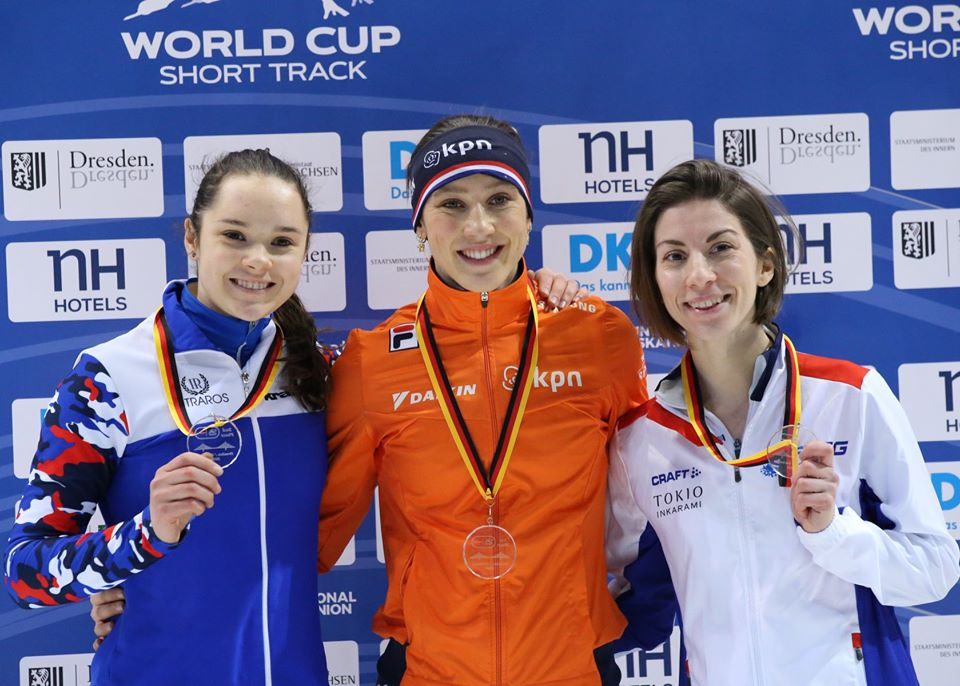
Cette saison, la patineuse avait en tête de remporter sa première médaille individuelle en Coupe du monde. Cet objectif a été atteint à Dresde lors de la cinquième manche de la saison. Une médaille de bronze sur 1500m, un podium où se retrouvait également la champione du monde 2019 Suzanne Schulting et la jeune sensation russe Sofia Prosvirnova. En plus de cette médaille individuelle Huot-Marchand, flanquée de ses acolytes, a remporté une médaille de bronze au relais par équipe mixte lors de la même manche de Coupe du monde. Quand on jette un œil aux différents classements de la saison, la Française a terminé au 11e rang sur 1500m, le meilleur résultat parmi tous les athlètes français en courte piste cette saison.

Lors de notre rencontre, l’athlète originaire de Besançon me confiait également souhaiter monter sur un podium lors des prochains Championnats du monde. La présentation des Championnats du monde 2020 étant toujours en péril, Huot-Marchand devra peut être attendre à l'an prochain pour impressionner la cours d'école.

Abonnez-vous à notre infolettre, suivez notre page Facebook, notre compte Instagram et notre compte Twitter pour ne manquer aucune nouvelle sur le patinage.  

Tifany Huot-Marchand: "Like in the school playground when we were kids."


Born in a small village of a hundred souls, it’s through a neighbor and her kids that young Tifany Huot-Marchand, nine years old at the time, discovered short track. She was invited by that neighbor, who had practice the sport in the past, to join them on a hour-long trip to Belfort to put on skates for the first time. An offer that would end up changing her life.

By Carl Savard
Photos by Oscar van den Bosch, Martin Holtom and Tifany Huot-Marchand's personal collection

The first day in school
I’ve heard many stories of how speed skating entered the life of athletes but few have made me smile as much as the  bucolic account of Tifany Huot-Marchand’s debut on skates. "I'd never been on skates before this impromptu outing with the neighbour and my friends. It was the first time I got on skates and it was on speed skates. My sister and I thought it was awesome. We were racing, going fast, having fun with our friends and that's how I ended up falling in love with short track. I used to play sports at school but I had never joined a club. Short track became my first official sport and for several years my parents drove an hour to the rink and back so that I could practice short track. I'll always be grateful to them for that." 

For a many years, practicing the sport was all fun for the French athlete. It’s only in 2010 when she joined the competitive training grounds of the CREPS Font Romeu, a high-level sports performance center located in the heart of the Catalan Pyrenees Regional Natural Park that things became more serious. But talking with Huot-Marchand is also having the impression of talking to French legend Thibaut Fauconnet: pleasure has to stay a major part of the process when reaching for the top. On that matter, she speaks highly of Fauconnet who just retired last summer and joined the coaching staff of the American short track team.  "I've learned a lot from Thibaut since I've been around him. By talking to him and watching him skate. I think you have to keep in mind that it's always going to be a game. Since I've known Thibaut, I see things differently and that's really calming me down. On the ice I tell myself we're all here as friends to race like we did in the school playground when we were kids."

Last year, Tifany Huot-Marchand expanded her competitive playground for a day taking part in an inline speed skating competition in Pamplona, Spain. Placed in the Elite category considering her status as an athlete on the ice made it for a tough first time. "I'm not very good in roller and since I had been placed in the Elite class I had to start among the bests. I wasn't expecting it to push that much and I fell, but it was still a really cool experience."


The new friends
While for many years the French team seemed to be mostly resting on Thibaut Fauconnet’s and Véronique Pierron’s shoulders, a breath of fresh air seems to have reach France as young skaters such as Gwendoline Daudet, Aurélie Monvoisin, Quentin Fercoq and Diané Sellier have come to support Tifany Huot-Marchand, Véronique Pierron, Tristan Navarro, Dimitry Migunov and Sébastien Lepape allowing France to get back into relay action. A situation that even though is not perfect, does bring  a smile to 25-year-old Huaut-Marchand. “It can sometimes be difficult to have a short track career in a country where the sport has no media coverage at all. There are very few licensees, hence the fact that there are few newcomers in the team. At the moment there is a revival. I hope that there will soon be another wave of athletes because it's good to have four girls, but it's still only four and it's sometimes difficult. I do feel we're really strong though. It's kind of the same scenario with the boys. It's been a long time since we've had this many of us getting on the road and competing and it feels good. It’s highly motivating to have a bigger team and it makes you feel stronger." 

Despite the many difficulties attached to being an elite athlete in a sport lacking media coverage and not offering a professional circuit where athletes could make more money,  Tifany Huot-Marchand can’t imagine her life without practicing the sport. "It's hard for me to describe how I feel on the ice. I'm having fun even in practice. In competition whether I cross the line in first or third place if I have given everything I have then I have no regrets. In terms of feelings, it may sound a bit cliché but sometimes you feel invincible, you feel like you're flying on the ice and that's exactly what I like and what I'm looking for."

Top of the class
This season, Tifany Huot-Marchand had in mind to win her first individual World Cup medal. This goal was achieved in Dresden in the fifth round of the season. A bronze medal in the 1500m, a podium that also featured the 2019 World Champion Suzanne Schulting and young Russian sensation Sofia Prosvirnova. In addition to this individual medal, Huot-Marchand and her teammates won a bronze medal in the mixed relay event at the same competition. When looking at the different rankings of the 2019-2020 season, the Besançon-born athlete finished 11th in the final ranking of the 1500m. She was without a doubt  the best French athletes in short track this season. When we met, she also confided to me that she would also like to be on the podium at the World Championships. Since the 2020 event is presently on hold, she may have to wait before impressing her friends in the school yard. 

Don't forget to subscribe to our newsletter, follow our Facebook page, our Instagram account and our Twitter account for daily news and results about speed skating.


21 février 2020

Deanna Lockett: The traveling Hungaroo


I know I've told you in the past but one thing I truly appreciate about covering a sport like short track is having the opportunity to meet people from all over the globe. It’s actually something a lot of athletes enjoy too but while some just surf on the opportunity, others push it further by moving to another part of the world to keep their dream alive and make the most out of it. That’s what Australian-born Deanna Lockett did.

By Carl Savard
Photos by Oscar van den Bosch and Deanna Lockett's personal collection

It’s with a big smile and a laid back attitude that the 24-year-old from Sunnybank, Australia sat with me for a chat last fall when the short track speed skating World cup circus was in Montreal. Lockett, who’s now representing Hungary, was ready to talk about her life as an elite athlete, but first I was curious to know how a kid from Australia ends up choosing a winter sport.


“I started skating when I was eight or nine. Most sports are played outside in the middle of the day in sunny Australia and I have a pretty light color skin and my dad was worried about skin cancer risks so we ended up at the ice rink. At first it was just for general skating sessions. I liked going really fast so I tried speed skating and fell in love with it. I didn’t grow up surrounded by athletes but I’ve always been competitive and from the get go I wanted to become a high level speed skater. I was sixteen when I skated in a World cup event for the first time and I didn’t expect much but I ended up making the B final on 1500m and was really shocked. I started thinking that maybe I could be a really good skater.”

Known for her endurance on the ice and in need of a change of pace after a few seasons on the international circuit in short track, Lockett decided to switch to long track and give it a try. Despite physically having the stamina needed to compete on the 400m oval, the Australian figured out quite fast that long track wasn’t for her. “I’m really good to keep a pace in short track but I’m not as good with the racing aspect so I thought long track would be good for me but it’s really different. I thought it would be a lot easier than it was. It was really hard. I trained for about three months in the Netherlands and I didn’t enjoy it. I couldn’t wait for the training sessions to be over. That’s when I decided to reach out to Hungary."

Outside of the the Netherlands, Hungary is probably the country that managed to have the biggest progression in the last eight years thanks to the prowess of the Liu brothers and the arrival of Zhang Jing as an advisor - and later coach - in 2012. Something else helping their program is their openness to the idea of welcoming athletes from elsewhere to either train or join their team. USA’s Cole Krueger started skating for Hungary last season while his brother John Henry, just like Lockett, started representing The Land of Magyars this season. Deanna Lockett knew she could have just surfed on the fact that it would have been a safe choice for her to stay in Australia and represent her native country at the Olympics three times, but she wanted more. She needed more. She felt she had to think outside of the box. “Although there wasn’t many skaters at my level to push me and train with me when I was there, Australia gave me so many opportunities and they did everything that they could. The thing is, I wanted to be part of a big team. I had the opportunity to train with big teams in the past, in Korea and elsewhere, but it’s not like having your own. I’m really grateful that Hungary has taken me on. Since I had train with them before I pretty much knew everyone and since I had to skip a season because I was going to skate for another country I had no pressure and just trained. The women’s team in Hungary lost a few older skaters, so there was an opening. It was kind of a perfect timing for me.“

Although the timing was perfect and she knew most of the people involved in the Hungarian program it’s still a huge change to settle elsewhere in the world and get a new citizenship. Lockett didn’t have clear goals for the season that's coming to an end other than getting accustomed to her new environment. “It’s been a lot to get used to Hungary, the program is different, I have a team now and also I skipped a year and I feel like the field as gotten stronger while I was away which is good but I’m not rushing for some results. I’m just skating and trying to enjoy what I’m doing . Maybe next season I’ll put more pressure on myself but I try to stay in the moment and not think to much ahead because when I think too ahead then I get too nervous.”

As a fan of short track since the end of the 80's, I’m always interested in knowing which national skater had an impact on an athlete when they were younger. Asking that question to a Dutch or a Canadian skater is easy since they have a lot of role models to pick from, asking it to someone from a country whose short track history is often linked to a historical anecdote at the 2002 Olympics (see Steven Bradbury) is another thing. For Deanna Lockett, one name popped in her head when I asked her the question and it's someone who had made similar career choices. “When I was between 10 and 12 years old, we had Tatiana Borodulina from Russia who skated for Australia. She won World cup medals and I’d say she was a pretty big inspiration for me. But other than that, I didn’t really look up to other skaters or even know about them too much before I showed up on the international scene.” 

Even when she was the only female skater representing Australia, Lockett was still able to perform to a high level. In 2017, she won her first medal on the World cup circuit, finishing third behind Choi Min Jeong and Kim Boutin on 1500m in Budapest. A year before, she had finished 4th on 1000m in Dresden. Now as a member of the Hungarian team and having the opportunity to compete in the relay events, Lockett knows her chances of visiting the podium in the near future are even better. “We need to adjust to one another and find our timing but I think our speed is good.” 

The traveling Hungaroo knows the life she’s living right now isn’t your regular everyday life and she tries to cherish every moment. “It’s great meeting people from other countries and spending time with them. You make new friends and learn things from other cultures. If you would have told me three years ago that I would become a Hungarian citizen I would have laughed at you. I now have three passports!*”

Deanna Lockett should be in action on the Mokdong Ice Rink in Seoul from March 13 to the 15 to compete one last time this season at the ISU Short track speed skating world championships.

Don't forget to subscribe to our newsletter, follow our Facebook page, our Instagram account and our Twitter account for daily news and results about speed skating.

*Before obtaining her Hungarian citizenship, Deanna Lockett already had an Australian and British passports.