Passion/Patin/Vitesse - Passion/Speed/Skating: mass start

Colombia and France stand out in Ibagué

Inline speed skating world championships recap

La Colombie et la France se démarquent à Ibagué

Résumé des championnats du monde de roller 2021

The Canada Roller Marathon 2021: Moving forward

Canada Roller Marathon is back after 2020 hiatus

Le marathon roller du Canada 2021: Aller de l'avant

Retour du Marathon roller du Canada après une pause en 2020

Nos autres adresses / Our other spaces

Venez nous rejoindre! / Come and join us!

Pages

Aucun message portant le libellé mass start. Afficher tous les messages

19 février 2022

Mass start gold for Swings and Schouten


The men and women's mass start were the last scheduled speed skating events at the Beijing Olympics, Bart Swings and Irene Schouten are the new Olympic champions. 

By Jackob Savard
Photo: Uks Zwolen-Team

While some semi-finals went to a sprint and others let a few skaters get in a breakaway, the majority of the favorites managed to reach the final. It should be noted that the reigning Olympic champion on the distance Nana Takagi fell while leading her semi-final and could not defend her Olympic title earned in Pyeonchang. 

Belgian Bart Swings won the men's final with a powerful last straight. The inline speed skating world champion worked very hard throughout the race to catch up with the breakaways. He defended his place in the sprint to finish in front of Korea's JaeWon Chung and Seung-Hoon Lee. American Joey Mantia finished fourth. 

In the women's race, Irene Schouten from the Netherlands won the final sprint just in front of Canadian Ivanie Blondin and Italian Francesca Lollobrigida. It was the fourth medal of the Dutch at these games.


Don't forget to subscribe to our newsletter, follow our Facebook page, our Instagram account and our Twitter account for daily news and results about speed skating. 


14 décembre 2018

Heerenveen day 1: mass start semi-finals

The fourth World cup of the season in long track speed skating started with the mass start semifinals today in Heerenveen, Netherlands.

By Jackob Savard
Photo: Jaap Hop (JH Sportfotografie)

Only the individual distances will be raced this weekend in Heerenveen for World cup #4 of the season. On day 1, mass start semifinals were the only races on the program.


Schouten and Blondin will enter the final as favorites
Crowd favorite and olympic medalist on the distance Irene Schouten won the first ladies’ semifinal sending a message to her rivals that she is the women to beat in Heerenveen. As for other skaters who qualified through the first heat, we found current World cup leader on the distance Bo Reum Kim and Pyeongchang 2018 4th place finisher in the mass start Saskia Alusalu from Estonia.

Former mass start world champion from Canada Ivanie Blondin won the second semifinal finishing just ahead of Olympic champion Nana Takagi from Japan and current World cup runner-up Francesca Lollobrigida from Italia.

Peter Michael dominates his heat
New Zealand’s long distance skater Peter Michael dominated the first semifinal finishing seven seconds before his closest rival and mass start winner in Obihiro, Andrea Giovannini. Mass start classification leader Cheonho Um, former world champion Joey Mantia and Dutch favorite Simon Schouten also got through this first semifinal. It was a tougher race for Olivier Jean from Canada who finished 10th.

Seventeen-year-old Korean skater Jaewon Chung won the second semifinal in front of Bart Swings and Daniel Niero. Niero who is an inline speed skating champion and an ice marathon skater will skate his first mass start A final in a World cup tomorrow. Chris Huizinga, Jordan Belchos, Ryosuke Tsuchiya, Zbigniew Bródka and Livio Wenger are the other skaters who qualified.

Don't forget to subscribe to our newsletter, follow our Facebook page, our Instagram account and our Twitter account for daily news and results about speed skating

30 octobre 2018

Longue piste: de nouveaux règlements pour la nouvelle saison

Le Comité technique de l’Union Internationale de patinage (ISU) et ses officiels se sont réunis durant l’été pour discuter des modifications à apporter aux règlements et discuter de l’ajout de nouvelles règles à mettre en vigueur en vue de la nouvelle saison et des suivantes.
Par : Maria Dalton
Photos par : Schaats Foto's
Nouveau format pour les Championnats du monde
partir de la saison 2020/2021, il n'y aura qu'un seul championnat du monde regroupant tous les championnats qui sont coursés sous le calendrier actuel.  Les dirigeants de l’ISU n'ont pas donné plus de détails sur le format de la compétition. Les détails seront approuvés et annoncés par l'Union internationale plus tard. Les raisons de ces changements sont les suivants:
- Donner plus de valeur au titre de « champion du monde »
- L’ISU donnera plus d’argent aux équipes pour le voyage au Championnat du monde
- Des bourses plus élevées pour les champions
- Des économies pour les équipes

*Les nouveaux Championnats des Quatre Continents seront introduits lors de la saison 2019/2020. Ce sera une compétition annuelle qui suivra le même format que les Championnats européens - mais les patineurs européens seront exclus de cette compétition. Le nombre de compétiteurs par pays pour cette compétition sera le même qu’aux Championnats du monde.
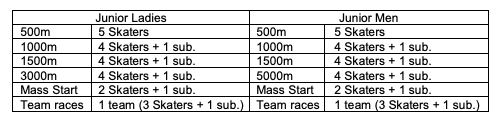
*Les Championnats du Monde Juniors et les Championnats Européens restent inchangés, à l'exception de l'ajout d'un tableau qui permet de préciser le nombre d'entrées par pays pour chaque distance aux Championnats du Monde Junior.
Changements au départ groupé
*Le système de points pour le départ groupé a été modifié chez les juniors et chez les séniors. Au niveau sénior, les points pour les sprints intermédiaires seront 3-2-1 et le sprint final verra des points attribués aux 6 premiers patineurs (60-40-20-10-6-3). Au niveau junior, il y aura maintenant deux sprints intermédiaires, dans le quatrième tour et le septième – les points attribués seront 3-2-1. Les points attribués pour le sprint final seront maintenant 30-20-10-4-2-1.
*Les patineurs qui ne terminent pas la course seront classés par le nombre de tours qu'ils auront complété. Selon l'ancienne règle, cela n'était pas obligatoire. Les patineurs qui abandonnent la course lors du même tour seront classés par leur dernier temps intermédiaire.
*Il y a des changements au règlement 253. Les mots “obstruction sérieuse” ont été remplacés par “comportement antisportif”. Avec ce changement, les officiels auront un éventail de motifs plus large pour disqualifier (DQ) des patineurs fautifs. De plus, un patineur lésé peut être avancé en ronde suivante à la discrétion de l'officiel.
*Le nombre de patineurs qui peuvent participer au départ groupé aux Championnats du monde juniors a été changé de 28 à 30 patineurs.
Quelques autres changements
* Tous les patineurs qui participent à la poursuite par équipe et au sprint par équipe devront porter un brassard coloré :
-       Patineur #1 : brassard blanc avec №1
-       Patineur #2 : brassard rouge avec №2
-       Patineur #3 : brassard jaune avec №3
-       Patineur #4 : brassard bleu avec №4


*Le terme "collision” a été changé pour “obstruction” dans la règle 257. Il ne sera plus nécessaire qu'une collision ait lieu entre deux patineurs pour avoir une disqualification.

Vous pouvez écouter la présentation complète en anglais

Assurez-vous de suivre notre page Facebook, notre
compte Instagram et notre compte Twitter pour ne
manquer aucune nouvelle sur le patinage de vitesse.

24 février 2018

Exciting mass start event to conclude the Olympics in speed skating


Mass start races concluded the speed skating events of the Olympics today at the Gangneung oval in front of a roaring crowd.

By Jackob Savard
Photos: Thomas di Nardo (https://www.thomasdinardo.com) & Schaats Foto’s

It was the first time that the spectacular mass start event was raced at the Olympic games.

Ladies’ semifinals
Francesca Lollobrigida from Italy was dominant in the first semifinal gathering some sprint laps’ points and crossing the finish line in first position. The inline speed skating specialist came to Pyeongchang as one of the favorite to win the mass start. Canada’s Keri Morrison did a perfect race and finished in third place to qualify for the final alongside Dan Guo, Irene Schouten, Nana Takagi and Kim Bo-reum who also finished in the top 8.

There was a bit more action in the second ladies semifinal as Ivanie Blondin fell and took out Ayano Sato and Annouk van der Weijden. Sato and Blondin, who are respectively fourth and sixth in the World cup classification, would not take part in the finale. Van der Weijden managed to come back to the pack and finished second despite the fall. A medal on the distance would help her sweetened her heartbreaking fourth place on 5000m.


Men’s semifinals
Linus Heidegger from Austria was the first to pass the finish line in the first semifinal after a little breakaway with Andrea Giovannini from Italy and Shane Williamson from Japan. The three qualified for the main event. Other favorites including Lee Seung-Hoon, Alexis Contin, Koen Verweij and Olivier Jean also qualified for the final as they concluded the race in the top 8.

Peter Michael raced with confidence in the second semi and was the first to finish the 16 laps race. Almost every skater got sprint points in this race and it was a matter of who got the most. Sven Kramer who was racing in his first mass start of the season did a solid race and collected 6 points to earn his ticket for the A final. Inline speed skating specialists Bart Swings, Livio Wenger and Joey Mantia also managed  to qualify.

Ladies' final
Saskia Alusalu started her race like she did in Calgary earlier this season by trying to escape the pack with a breakaway. The pack came back on her with 3 laps to go to prepare for the sprint. Nana Takagi from Japan won the sprint finishing ahead of crowd favorite’s Kim Bo-reum and Irene Schouten from the Netherlands. Alusalu got fourth place with the 15 points she won in the intermediate sprints. Lollobrigida who’s leading the mass start World cup classification finished in 7th.


Men’s final
A lot of skaters tried to escape from the pack in the final but it was finally the sprint that decided the podium. Nobody was able to beat Korean star Lee Seung-hoon in the last stretch. His 16 years old teammate Jaewon Chung as a little bit to do with this victory as he leaded the chase group for a long time to help Lee come back on the breakaway and fight in the sprint. Bart Swings from Belgium and Koen Verweij from the Netherlands finished in second and third. Livio Wenger who was in the breakaway for the majority of the race finished fourth with 11 points. The 2017 World championships medalists on the distance Joey Mantia, Alexis Contin et Olivier Jean had a difficult race and finished 9th, 10th and 14th.

That’s it for speed skating at the Olympic games! The next long track event will be the Sprint world championships that will be held in Changchun, China on 3th and 4th March.

Visit our special coverage page to find all our articles related to Pyeongchang 2018 by clicking HERE